
Researching a stock trade before investing is one of the most important skills every investor must develop. Successful investing is not about luck, tips, or speculation. It is about making informed decisions based on careful analysis, data, and a clear investment framework. Investors who consistently research their stock trades thoroughly tend to minimize risk and improve long-term returns.
Many beginners make the mistake of buying stocks based on headlines, social media trends, or fear of missing out. While markets can reward speculation in the short term, long-term success almost always comes from disciplined research. Understanding what you own and why you own it provides confidence during market volatility and prevents emotional decision-making.
This article outlines five essential steps to researching a stock trade before investing. These steps provide a structured, repeatable process that can be applied to any stock, market condition, or investment style.
Once you determine which business cycle the economy is currently in you can start researching for a trade. It is best to have some sort of a system in place that will be used before EACH trade. Here is a simple 5 Step formula to help get you started.
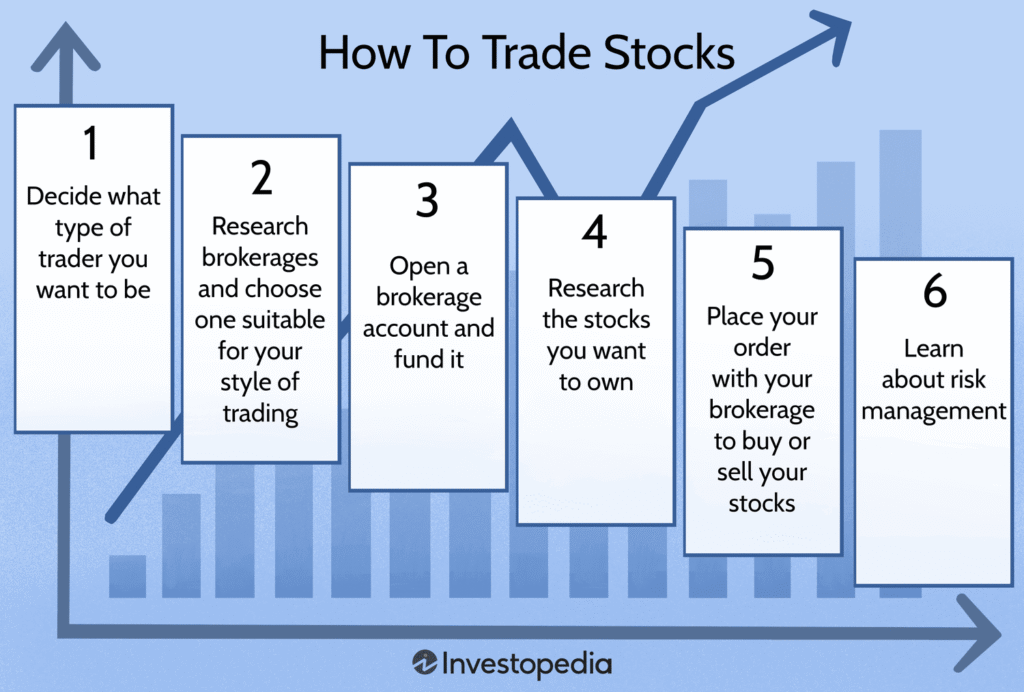
5 Steps to Investing Online:
1. Find a stock
This is the most obvious and most difficult step in stock trading. With well over 10,000 stocks to trade a good rule of thumb to consider is time of the year. For example, as I write this, it is the beginning of spring. It would make sense to consider stocks that traditionally make runs, or slide if you are bearish, during this time of year.
2. Fundamental Analysis
Many short term traders may disagree with the need to do ANY Fundamental Analysis, however knowing the chart patterns from the past and the news regarding the stock is relevant. An example would be earnings season. If you are planning
on playing a stock to the upside that has missed its earnings target the last 3 quarters, caution could be in order.
3. Technical Analysis
This is the part where indicators come in. Stochastics, the MACD, volume, moving averages, RSI, CCI, support levels, resistance levels and all the rest. The batch of indicators you choose, whether lagging or leading, may depend on where you get your education.
Keep it simple when first starting out, using too many indicators in the beginning is a ticket to the land of big losses. Get very comfortable using one or two indicators first. Learn their intricacies and you’ll be sure to make better trades.
4. Follow your picks
Once you have placed a few stock trades you should be managing them properly. If the trade is meant to be a short term trade watch it closely for your exit signal. If it’s a swing trade, watch for the indicators that tell you the trend is shifting. If it’s a long term trade remember to set weekly or monthly checkups on the stock.
Use this time to keep abreast of the news, determine your price targets, set stop losses, and keep an eye on other stocks that you may want to own as well.
5. The big picture
As the saying goes, all ships rise and fall with the tide. Knowing which sectors are heating up stacks the chips in your favor.
For example, if you are long (expecting price to go up) on an oil stock and most of the oil sector is rising then more likely than not you are on the right side of the trade. Several trading platforms will give you access to sector-wide information so that you can get the education you need.
WHY STOCK RESEARCH IS CRITICAL BEFORE INVESTING
Stock research helps investors identify quality opportunities while avoiding unnecessary risks. Thorough research allows investors to understand a company’s business model, financial strength, growth potential, and valuation. Without proper research, investing becomes gambling.
Researching a stock trade also helps align investments with personal financial goals, risk tolerance, and time horizon. Investors who conduct proper research are better prepared to hold positions through market cycles.
OVERVIEW: THE 5 STEPS TO RESEARCHING A STOCK TRADE
The process of researching a stock trade can be broken down into five essential steps:
1. Understand the company and its business model
2. Analyze financial performance and fundamentals
3. Evaluate valuation and price attractiveness
4. Assess risks and competitive position
5. Plan the trade and investment strategy
Each step builds on the previous one. Skipping any step increases the likelihood of poor investment decisions.
STEP 1: UNDERSTAND THE COMPANY AND ITS BUSINESS MODEL
The first step in researching a stock trade is understanding the company behind the stock. A stock represents ownership in a business, not just a ticker symbol.
Investors should ask fundamental questions such as:
– What products or services does the company sell?
– Who are its customers?
– How does the company make money?
– What industry does it operate in?
A clear understanding of the business model reduces uncertainty and improves conviction.
Industry and Market Position
Understanding the industry helps investors evaluate growth potential and competitive dynamics. Investors should analyze industry trends, market size, and whether the industry is growing, stable, or declining.
Companies with strong market positions are often better equipped to handle competition and economic downturns.
STEP 2: ANALYZE FINANCIAL PERFORMANCE AND FUNDAMENTALS
Financial analysis is the backbone of stock research. Strong fundamentals indicate a healthy business capable of generating long-term value.
Revenue and Earnings Growth
Consistent revenue and earnings growth signal strong demand and effective execution. Investors should review financial statements over multiple years to identify trends rather than relying on a single period.
Profitability and Margins
Key profitability metrics include gross margin, operating margin, and net profit margin. Stable or improving margins often indicate pricing power and operational efficiency.
Balance Sheet Strength
A strong balance sheet reduces financial risk. Investors should analyze debt levels, cash flow, and liquidity ratios. Companies with excessive debt are more vulnerable during economic downturns.
Cash Flow Analysis
Cash flow is more difficult to manipulate than earnings. Strong operating and free cash flow support reinvestment, dividends, and debt reduction.
STEP 3: EVALUATE VALUATION AND PRICE ATTRACTIVENESS
Even a great company can be a poor investment if purchased at the wrong price. Valuation helps investors determine whether a stock is undervalued, fairly valued, or overvalued.
Common Valuation Metrics
Common valuation tools include price-to-earnings ratio, price-to-book ratio, price-to-sales ratio, and free cash flow yield. These metrics should be compared to historical averages and industry peers.
Intrinsic Value and Margin of Safety
Intrinsic value represents the estimated true worth of a business. Buying below intrinsic value provides a margin of safety, reducing downside risk.
Avoiding Overpriced Stocks
Stocks driven by hype or unrealistic growth expectations carry higher risk. Investors should remain disciplined and patient, waiting for attractive entry points.
STEP 4: ASSESS RISKS AND COMPETITIVE POSITION
Every investment carries risk. Identifying risks before investing helps investors prepare for potential challenges.
Business and Industry Risks
Common risks include economic downturns, regulatory changes, technological disruption, and shifting consumer preferences.
Competitive Advantage
Companies with strong competitive advantages, such as brand loyalty or high switching costs, are more likely to sustain profitability.
Management and Governance Risks
Poor management decisions can destroy shareholder value. Investors should evaluate leadership quality, incentives, and corporate governance.
STEP 5: PLAN THE TRADE AND INVESTMENT STRATEGY
The final step in researching a stock trade is creating a clear investment plan.
Define Investment Goals
Investors should define whether the stock is intended for long-term growth, income, or short-term opportunities.
Entry Strategy
Determine an appropriate entry price based on valuation and market conditions. Investors may choose to invest gradually to manage risk.
Position Sizing and Risk Management
Proper position sizing prevents a single investment from dominating the portfolio. Higher-risk trades should be allocated smaller positions.
Exit Strategy
An exit strategy helps investors avoid emotional decisions. Selling should be based on changes in fundamentals, valuation, or better opportunities.
COMMON MISTAKES WHEN RESEARCHING STOCK TRADES
Common mistakes include relying on tips, ignoring financial statements, overconfidence, and lack of risk management. Avoiding these mistakes significantly improves investment outcomes.
TOOLS AND RESOURCES FOR STOCK RESEARCH
Useful resources include annual reports, earnings call transcripts, financial databases, stock screeners, and valuation models. Reliable information supports better decision-making.
CONCLUSION
Researching a stock trade before investing is essential for long-term success. By following these five steps, investors can make informed decisions, reduce risk, and improve consistency.
Successful investing is not about being right all the time, but about following a disciplined process and managing risk effectively.


Tinggalkan Balasan