
Profitable stock picking is one of the most powerful methods for building long-term wealth in the stock market. While many investors choose index funds for simplicity, those who master profitable stock picking gain the ability to outperform the market by carefully selecting high-quality companies and investing in them at the right price. This approach requires patience, discipline, and a structured investment process.
Profitable stock picking is not about predicting short-term price movements or reacting to daily market news. Instead, it is about understanding businesses, analyzing financial data, and making rational decisions based on long-term value. Investors who consistently succeed follow a clear framework that guides their decisions and reduces emotional mistakes.
This article presents a complete guide to profitable stock picking using three proven steps. These steps are suitable for beginners and experienced investors alike and are designed to be repeatable across different market conditions.
Stock picking is a very complicated process and investors have different approaches. However, it is wise to follow general steps to minimize the risk of the investments. This article will outline these basic steps for picking high performance stocks.
Step 1. Decide on the time frame and the general strategy of the investment. This step is very important because it will dictate the type of stocks you buy.
Suppose you decide to be a long term investor, you would want to find stocks that have sustainable competitive advantages along with stable growth. The key for finding these stocks is by looking at the historical performance of each stock over the past decades and do a simple business S.W.O.T. (Strength-weakness-opportunity-threat) analysis on the company.
If you decide to be a short term investor, you would like to adhere to one of the following strategies:
a. Momentum Trading. This strategy is to look for stocks that increase in both price and volume over the recent past. Most technical analyses support this trading strategy. My advice on this strategy is to look for stocks that have demonstrated stable and smooth rises in their prices. The idea is that when the stocks are not volatile, you can simply ride the up-trend until the trend breaks.
b. Contrarian Strategy. This strategy is to look for over-reactions in the stock market. Researches show that stock market is not always efficient, which means prices do not always accurately represent the values of the stocks. When a company announces a bad news, people panic and price often drops below the stock’s fair value. To decide whether a stock over-reacted to a news, you should look at the possibility of recovery from the impact of the bad news. For example, if the stock drops 20% after the company loses a legal case that has no permanent damage to the business’s brand and product, you can be confident that the market over-reacted. My advice on this strategy is to find a list of stocks that have recent drops in prices, analyze the potential for a reversal (through candlestick analysis). If the stocks demonstrate candlestick reversal patterns, I will go through the recent news to analyze the causes of the recent price drops to determine the existence of over-sold opportunities.
Step 2. Conduct researches that give you a selection of stocks that is consistent to your investment time frame and strategy. There are numerous stock screeners on the web that can help you find stocks according to your needs.
Step 3. Once you have a list of stocks to buy, you would need to diversify them in a way that gives the greatest reward/risk ratio. One way to do this is conduct a Markowitz analysis for your portfolio. The analysis will give you the proportions of money you should allocate to each stock. This step is crucial because diversification is one of the free-lunches in the investment world.
These three steps should get you started in your quest to consistently make money in the stock market. They will deepen your knowledge about the financial markets, and would provide a sense of confidence that helps you to make better trading decisions.
WHY PROFITABLE STOCK PICKING MATTERS
Profitable stock picking allows investors to take control of their investment decisions. By choosing individual stocks, investors can focus on companies they understand, avoid overvalued sectors, and allocate capital based on conviction rather than index weighting.
Another advantage of profitable stock picking is the opportunity to benefit from market inefficiencies. Markets are not always perfectly efficient, and mispriced stocks appear regularly due to fear, uncertainty, or short-term thinking. Long-term investors can take advantage of these opportunities.
Additionally, profitable stock picking encourages a deeper understanding of how businesses operate. This knowledge improves decision-making and builds confidence during market volatility.
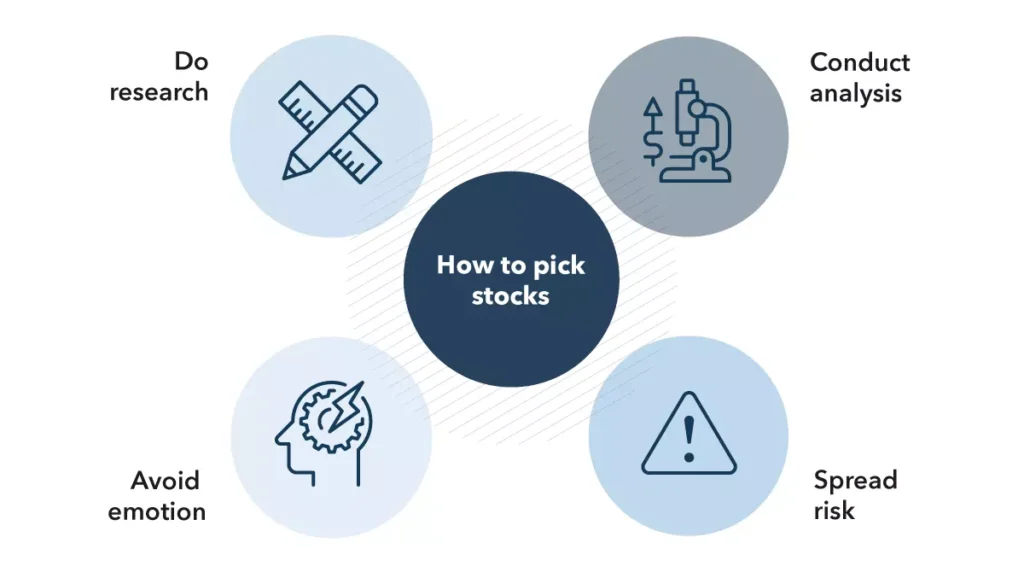
OVERVIEW: THE 3 STEPS TO PROFITABLE STOCK PICKING
The process of profitable stock picking can be summarized into three essential steps:
1. Identify high-quality businesses
2. Buy stocks at the right price
3. Manage risk and invest with discipline
Each step plays a critical role. Identifying a great company without considering valuation can lead to poor returns, while buying a cheap stock without understanding the business can result in permanent capital loss.
STEP 1: IDENTIFY HIGH-QUALITY BUSINESSES
The first and most important step in profitable stock picking is selecting high-quality businesses. Over the long term, stock prices tend to reflect the underlying performance of the company. Strong businesses create value for shareholders through earnings growth, cash flow, and competitive advantages.
Consistent Revenue and Earnings Growth
High-quality companies typically demonstrate consistent revenue and earnings growth over many years. This consistency shows that the company’s products or services are in demand and that management can execute its strategy effectively.
When analyzing revenue growth, investors should look for:
– Stable or increasing sales over at least five to ten years
– Growth that outpaces inflation
– Expansion into new markets or product lines
Sustainable Competitive Advantage
A sustainable competitive advantage, often referred to as an economic moat, protects a company from competitors. Companies with strong moats can maintain profitability even as competition increases.
Common sources of economic moats include strong brand recognition, network effects, high switching costs, cost leadership, and regulatory barriers. Businesses with durable competitive advantages are ideal candidates for profitable stock picking.
Profitability and Margin Stability
Profit margins indicate how efficiently a company converts revenue into profit. High and stable margins suggest pricing power and efficient operations.
Key margins to analyze include gross margin, operating margin, and net profit margin. Investors should compare these metrics to industry peers to gain context.
Strong Balance Sheet and Financial Health
A strong balance sheet reduces financial risk and allows companies to survive economic downturns. Investors should evaluate debt levels, cash reserves, and liquidity ratios.
Companies with manageable debt and strong cash flow are better positioned to invest in growth opportunities and withstand market stress.
Management Quality and Corporate Governance
Management plays a critical role in long-term business success. Good management teams allocate capital wisely, communicate transparently with shareholders, and focus on long-term value creation.
Signs of strong management include consistent execution, insider ownership, and a clear strategic vision.
Understandable Business Model
Successful stock pickers invest in businesses they understand. If an investor cannot clearly explain how a company makes money, the investment carries unnecessary risk.
STEP 2: BUY STOCKS AT THE RIGHT PRICE
Valuation is a key element of profitable stock picking. Even the best company can produce poor returns if purchased at an excessively high price.
Understanding Stock Valuation
Valuation measures how much investors are paying for a company’s earnings, assets, or cash flow. Common valuation metrics include the price-to-earnings ratio, price-to-book ratio, price-to-sales ratio, and free cash flow yield.
No single valuation metric should be used in isolation. Valuation must be considered in relation to growth prospects, profitability, and industry conditions.
Intrinsic Value and Margin of Safety
Intrinsic value represents the estimated true value of a business based on its future cash flows. Buying stocks below intrinsic value provides a margin of safety, which protects investors from errors in judgment and unexpected events.
The margin of safety principle is central to long-term profitable stock picking.
Avoiding Overvaluation and Market Hype
Many investors lose money by chasing popular stocks trading at extreme valuations. High expectations leave little room for error, increasing downside risk.
Profitable stock picking requires patience and the willingness to wait for attractive entry points.
Market Timing Versus Valuation Discipline
Rather than attempting to time the market, investors should focus on valuation and business fundamentals. Market corrections often present excellent opportunities to buy quality stocks at discounted prices.
STEP 3: MANAGE RISK AND INVEST WITH DISCIPLINE
Risk management separates successful investors from unsuccessful ones. Even the best stock pickers experience losses, but disciplined risk management prevents small mistakes from becoming catastrophic.
Diversification
Diversification reduces the impact of individual stock failures. Holding a portfolio of 10 to 20 stocks across different sectors is often sufficient for individual investors.
Position Sizing
Position sizing ensures that no single investment dominates the portfolio. Higher-risk stocks should be allocated smaller positions, while high-conviction ideas can justify larger allocations.
Long-Term Mindset
Profitable stock picking requires a long-term perspective. Short-term price volatility is inevitable, but business value tends to grow steadily over time.
Emotional Discipline
Emotions such as fear and greed can lead to poor decisions. Successful investors rely on research, predefined rules, and patience rather than emotional reactions.
Knowing When to Sell
Selling decisions should be based on changes in business fundamentals, excessive valuation, or better opportunities. Panic selling during market downturns often leads to regret.
COMMON MISTAKES IN PROFITABLE STOCK PICKING
Common mistakes include lack of research, ignoring valuation, overconfidence, overtrading, and poor diversification. Avoiding these mistakes significantly improves long-term results.
TOOLS AND RESOURCES FOR PROFITABLE STOCK PICKING
Useful tools include financial statements, stock screeners, earnings call transcripts, valuation models, and long-term performance charts. Reliable data supports better investment decisions.
CONCLUSION
Profitable stock picking is a disciplined process focused on quality, valuation, and risk management. By following these three steps consistently, investors can improve decision-making and achieve sustainable long-term returns. Patience, discipline, and rational thinking are the true foundations of profitable stock picking.




Tinggalkan Balasan